The core of “The Right Stuff,” on Criterion 4K Blu-ray next week, a film that, if it’s not the Great American Movie, belongs on a short list with pictures like “The Best Years of Our Lives” and “The Magnificent Ambersons,” comes early. It’s dusk in the California desert and war hero and test pilot Chuck Yeager (Sam Shepard) stalks a slow circle around the Bell X-1 experimental aircraft with which he will break the sound barrier the next morning. Yeager, slim and handsome, wearing a brown flight jacket and corduroys, rides a horse. He seems wary of the plane. It’s a blunt metal thing. A marvel of technology, orange, shaped like a bullet, belching fire as its rocket propulsion is tested, hooked up to a tanker feeding it liquid fuel. Heat waves distort the air. Yeager is a knight, and the X-1 is the dragon.
Bill Conti’s Oscar-winning score magnifies the menace, rumbling in the woofer like the growls of the demon engineers in 1947 who worried lurked “out in the thin air,” waiting on the brave men spending their lives on Icarean folly at Muroc Army Air Field, waiting their turn to shatter their metal and glass vessels against the brick wall where they’re going so fast, air can no longer get out of their way. Did I say Yeager was a knight? In the United States, our mythology recasts the knight as the cowboy, and the question before Yeager is the one presented to another folk hero: steel-driving John Henry, who loses his life to a steam engine. The enemy of the past is the present and the future. In speaking with cinematographer Caleb Deschanel, he says:
“That scene sets it up. All my life, I always wanted to do a Western. And to me, “The Right Stuff” is a Western. That scene is, I mean, it’s like John Wayne coming up to the monolith in “2001: A Space Odyssey.” There’s no doubt for me that this is a Western at that point… confronting the future. He’s wondering about it and being intrigued by it and finally, ultimately, being sort of left behind by it. It was representative of an end of an era. That’s what I loved about [this scene]. It’s really a critical moment… it sets up where we were going with this whole thing.”
Phil Kaufman’s “The Right Stuff” is a historical epic, a taut docudrama, an effective melodrama about reckless men and the women they leave behind to worry and grieve their folly. It is deeply serious about matters of life and death, and it is simultaneously light comedy unto slapstick. Look at the introduction of a pair of harried functionaries, played by ridiculously height-mismatched Jeff Goldblum and Harry Shearer, who are always a few steps slow in delivering breaking news to powerful men.
They bicker like Laurel & Hardy, like an old married couple about the particulars of the ramshackle presentations they’re forever delivering to boardrooms full of cigarette smoke and serious men in rumpled suits. “We like the one on the right… no, the left. The right?” They’re Abbott and Costello. In the film, when they arrive at “Pancho’s Happy Bottom Riding Club” (then renamed Edwards Air Force Base in 1950) to recruit the first generation of “astronauts” in 1958, they accidentally put on each other’s comically wrong-sized jackets. It’s a clown show.
See, the Soviets had embarrassed the United States by sending the first unmanned vehicle into outer space in 1957, and the way “The Right Stuff” represents our humiliation at the hands of our once-allies, now-Cold War adversaries, is through the antics of these amiable, dedicated bumblers. The big picture, what one senator dubs “the ultimate battle between good and evil,” is here cannily illustrated by a stand-up team improvising their lines. Kaufman discovers a way we can empathize with people called to be extraordinary by their allegiance to duty, God, and country. He focuses on their humanity.
But every human accomplishment is a product of flawed people, isn’t it? The question “The Right Stuff” seeks to answer is what “the right stuff” is and how some manage to discover it when it’s needed the most. Deschanel says “I think it’s essential for human survival, for the sake of the human spirit that we have to have things that are beyond our capabilities. We have to be willing to explore.” Yeager, in attempting years later to fly faster than Mach 2 and thus regain the title of “fastest man in the world,” says he’s going to “push the envelope a little bit.” Deschanel recalls how the real General Chuck Yeager, a consultant on the film, would walk into a room and people would recognize somehow that there was something special about him. “The right stuff” is ineffable. He says:
“…having the right stuff means you can perform all these feats. But to me, it was more this subconscious evidence of how you just know it when someone like that walks in the room. It’s almost like, you know, some kind of subconscious understanding of this is someone.”
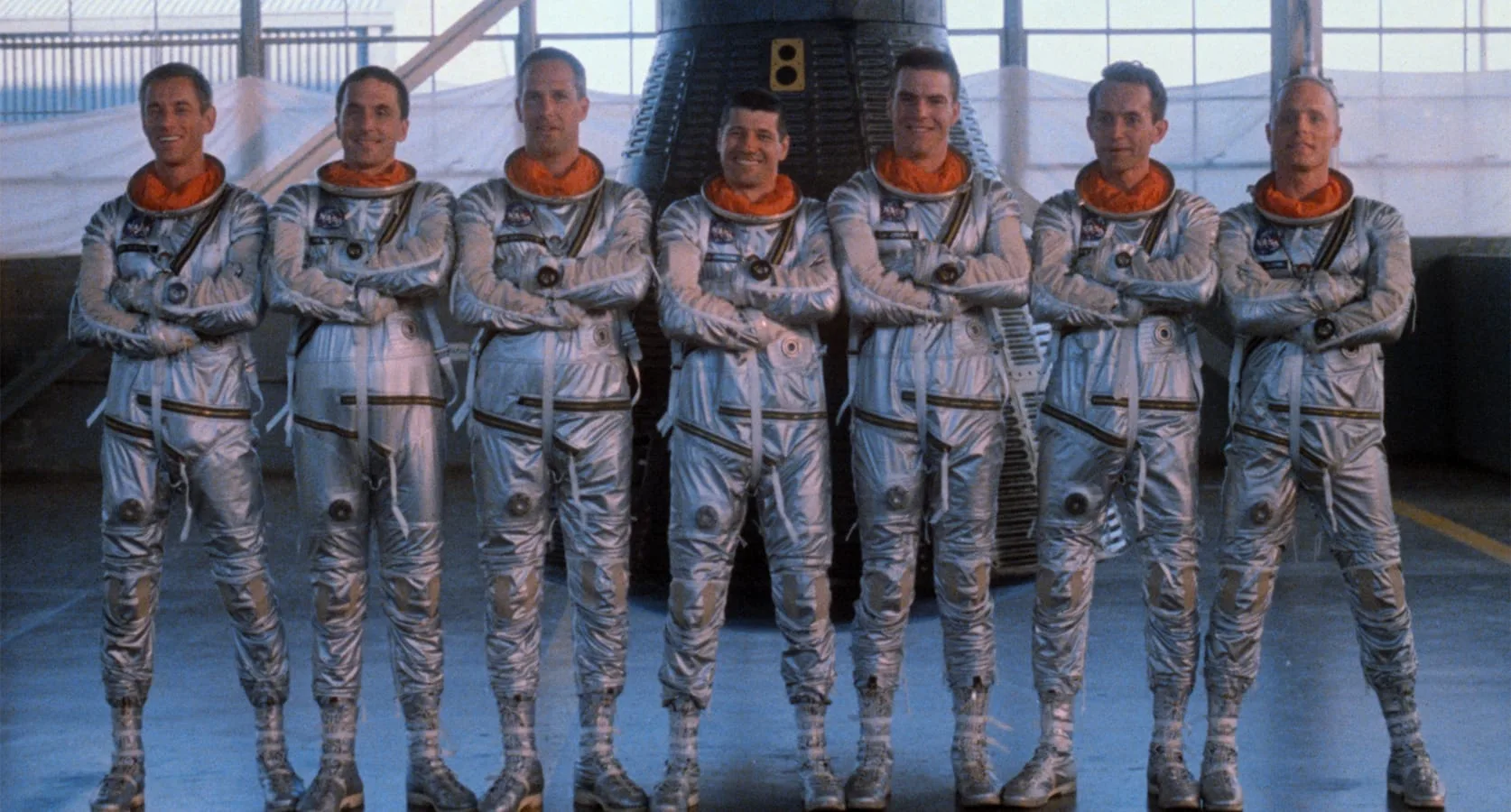
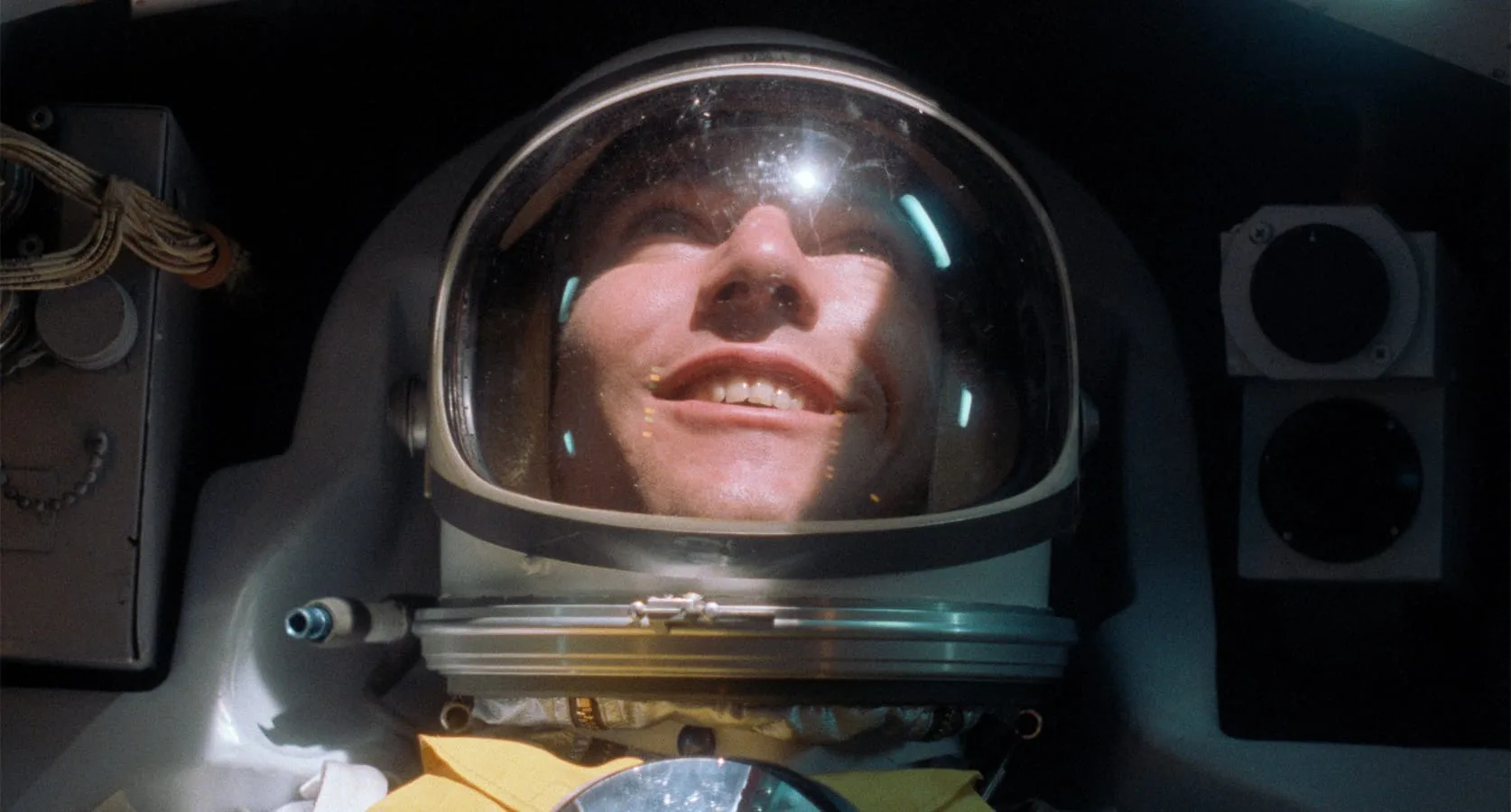
Seven men are chosen for the Mercury Program from each branch of the armed services. They’re put through extensive physiological and psychological testing, and “The Right Stuff” tracks their evolution from arrogant, capable but anonymous military men into canny managers of their image and manipulators of the media that wants to frame them as the country’s greatest pilots.
The problem is, the plan from the beginning was to send these men into space in windowless, unpiloted capsules designed to be shot into space and then dropped back into the ocean, hopefully, with its passenger still alive. “Astronauts?” Yeager scoffs, “More like Spam in a can.”
At almost exactly the halfway point of the film, we go back to Edwards Air Force Base after time with the Mercury Seven to check in with the cowboy, with Chuck Yeager, to find him alone in the dark, his friends and peers and competitors carousing in Pancho’s behind him, gazing up at the moon and thus inspiring our own musings about envelopes this country used to push with regularity. Our President used to give us timelines for when we were going to the moon and then, even after he was felled by an assassin’s bullet, made good on that promise. It’s hard to remember now, but there was a time we did things besides nurse capital.
“The Right Stuff” loves the idealism that animated the foundation of this country. This country has never truly lived up to that idealism but for a few shining, shivering moments when we were inspiring, and beautiful, and full of grace. The Mercury, Gemini, Apollo, and Space Shuttle missions represent so many of these moments: collisions of science, math, sinew, bone, and dreaming.
Yes, we were in a Cold War. Yes, the pursuit of knowledge consumed resources that might have gone to social projects and campaigns for justice and equality. And yes, we did this. Deschanel says, “It’s about characters who are willing to put their lives on the line and go out there to try to explore the limits of human understanding, and I just found it really wonderful.” It’s really wonderful.
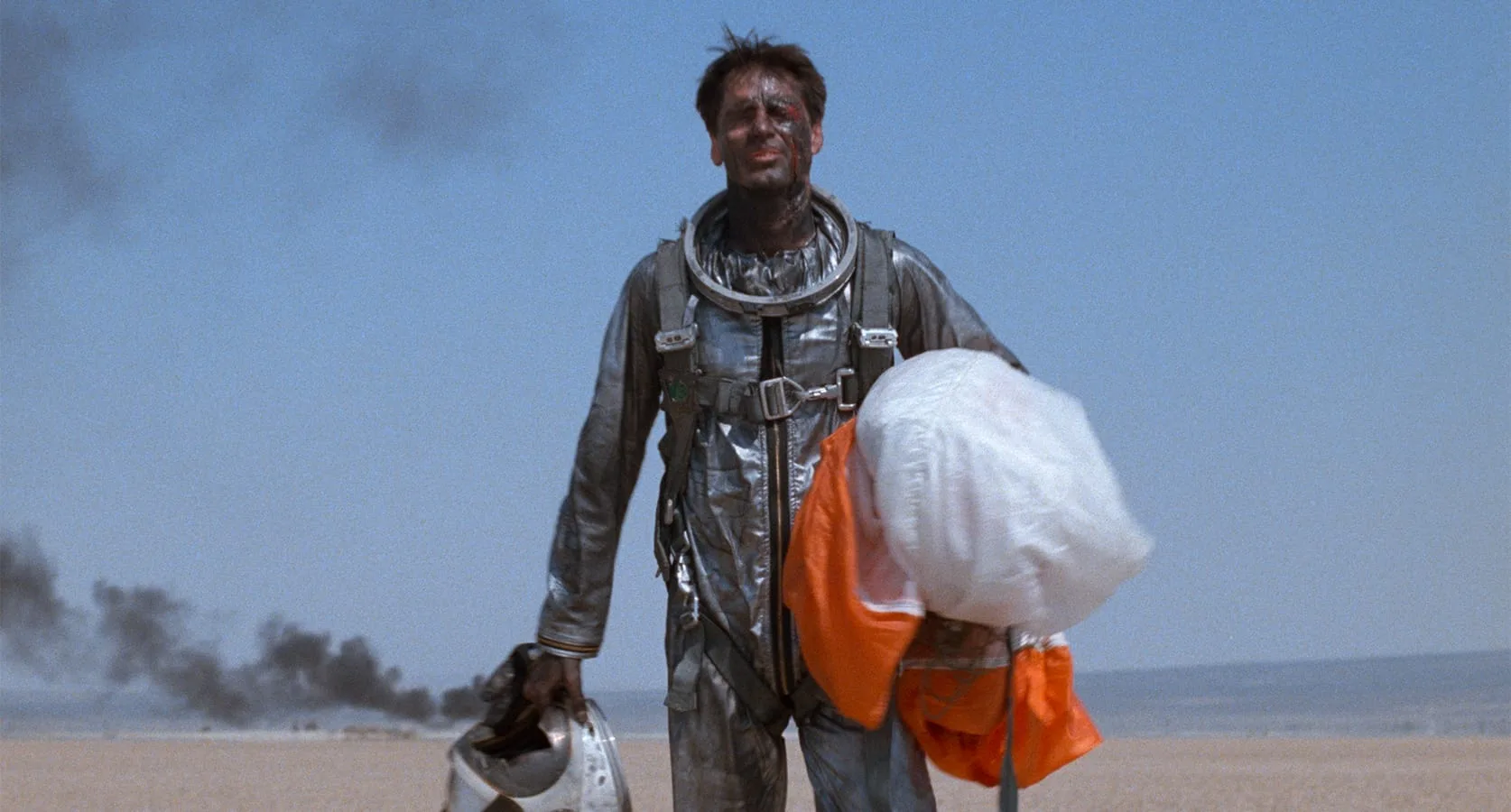
And through all that wonder, “The Right Stuff” never fails to measure the toll of adding to the pool of what is knowable to the people involved and the people they’ve left behind. It pulls tension from who will be the first of the seven into space; of who will be the first to orbit; but also of whether the riddle of John Glenn’s (Ed Harris) standoffish wife Annie (Mary-Jo Deschanel, wife of DP Caleb Deschanel) will be solved by the other wives; or if obnoxious Gordo Cooper’s (Dennis Quaid) long-suffering wife Trudy (Pamela Reed) will continue to stand by his side.
There are over 100 speaking parts in “The Right Stuff,” and I swear each one of them feels like a fully fleshed person with an entire history and an interior life that is as full and complicated as Yeager or Alan Shepherd (Scott Glenn), the fascinatingly blustery Gus Grissom (Fred Ward), whose real-life counterpart will die after the events of the film in a tragic fire during the Apollo missions. Credit for the piece’s verisimilitude goes to Thomas Wolfe’s meticulously researched novel, of course. But I would argue that the lion’s share of the film’s success comes down to Kaufman, who joined the project after a long development period during which the legendary William Goldman had already completed a script. Kaufman discarded it because it didn’t include Yeager because, as he tells John Wilford in a 1983 interview for The New York Times, “if you’re tracing how the future began, the future in space travel, it began really with Yeager and the world of the test pilots. The astronauts descended from them.” When Wolfe declined to adapt his own work, Kaufman did it himself in just two months. He was inspired.
For Kaufman, this needed to be a genealogy more than an adventure yarn or further hagiography of a group of men already lionized by history—mythologized, if you will—by the American urge to make heroes into icons and then commodities. Which is not to say that “The Right Stuff” is a salacious anti-epic interested in “taking down” the Mercury Seven, but rather to offer that “The Right Stuff” is a romance about how ordinary men under ordinary circumstances may never discover that there is magic in them if only the angels of their better nature were called to battle.
For Kaufman, it’s not the story of men who already had “the right stuff”; his Yeager is, after all, left behind in the literal dust of this tale, but rather the story of men who grow into the roles history wrote for them. It’s aspirational. The whole film has that curious quality of simultaneously foregone and in progress. All of this has happened, and yet there’s terror and anticipation, joy and celebration, life most of all, and the glory of being alive in a world full of mysteries. Crucially, it’s about the will of brilliant, courageous people to venture into the unknown armed with our impossibly primitive science and our oft-misguided faith as our sword and shield.
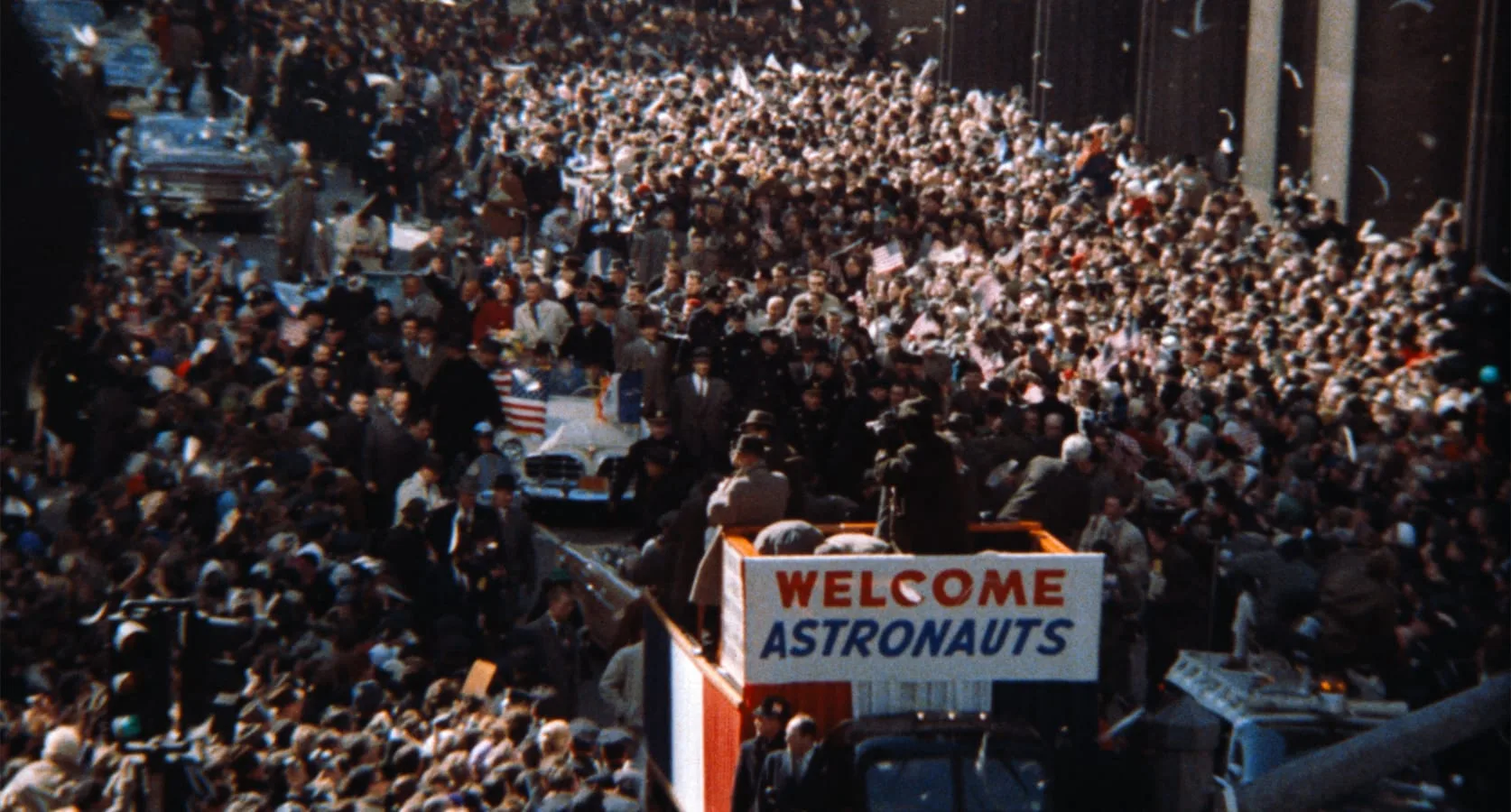
The astronauts enjoy their fame before they’re hounded by it, and “The Right Stuff,” as it does throughout, dramatizes this as a series of successes until the beginning of the last third of the film, when astronaut Grissom panics upon reentry and causes a valuable craft and the data it collected to sink to the bottom of the ocean. As his life is pulled apart by his shame about the mishap and his wife’s (Veronica Cartwright) disappointment, Kaufman returns again to Yeager, who defends the astronaut’s courage in undertaking a “suicide mission.”
What he doesn’t say, but we know, is that the astronauts are doing it to defend the honor and the legacy of pioneers like himself. Their responsibilities as heirs to every heroic sacrifice that came before them in the name of human adventure are clear to Yeager and to everyone who has risked everything in pursuit of substance and eternity. The next scene is Pancho’s burning down, another landmark returned to ash. Yeager and his wife, Glennis (Barbara Hershey), visit the ruins, and she tells him she was attracted to him because she liked “the kind of man who could push the outside of the envelope,” but that she would leave him if he ever lived in the past. If he ever rested on former glories. If he ever tried to find sustenance in salt and ash.
It would be a helluva thing to say in a movie that is merely a memorial, as static and sterile as that term suggests, but “The Right Stuff” is not that. Deschanel explains: “This film is announcing the future and leaving these men behind, but it’s honoring them, too. It’s honoring all these guys who put their lives on the line to advance America, science, and humanity into the future. That’s mythological.”
The first time I saw “The Right Stuff,” I was eleven, and I loved it with all of my heart. Not because of the rockets and airplanes, the brave men doing brave things, but because of Annie Glenn. Annie has a terrible stutter, much like mine as a child, which made her initially disliked by others and misunderstood and resented by none other than John F. Kennedy’s vice president, Lyndon Johnson (Donald Moffat), when she refuses to meet with him. I saw myself in this performance, the part I was most ashamed of, for the first time in anything. The last time, too, truth be told. Her husband stands up for her without hesitation or ambiguity. This is predicted by an earlier scene in which they share a moment of extraordinary intimacy, telling each other about their hopes and dreams. They tease each other, laugh, and love each other for their faults, not in spite of them.
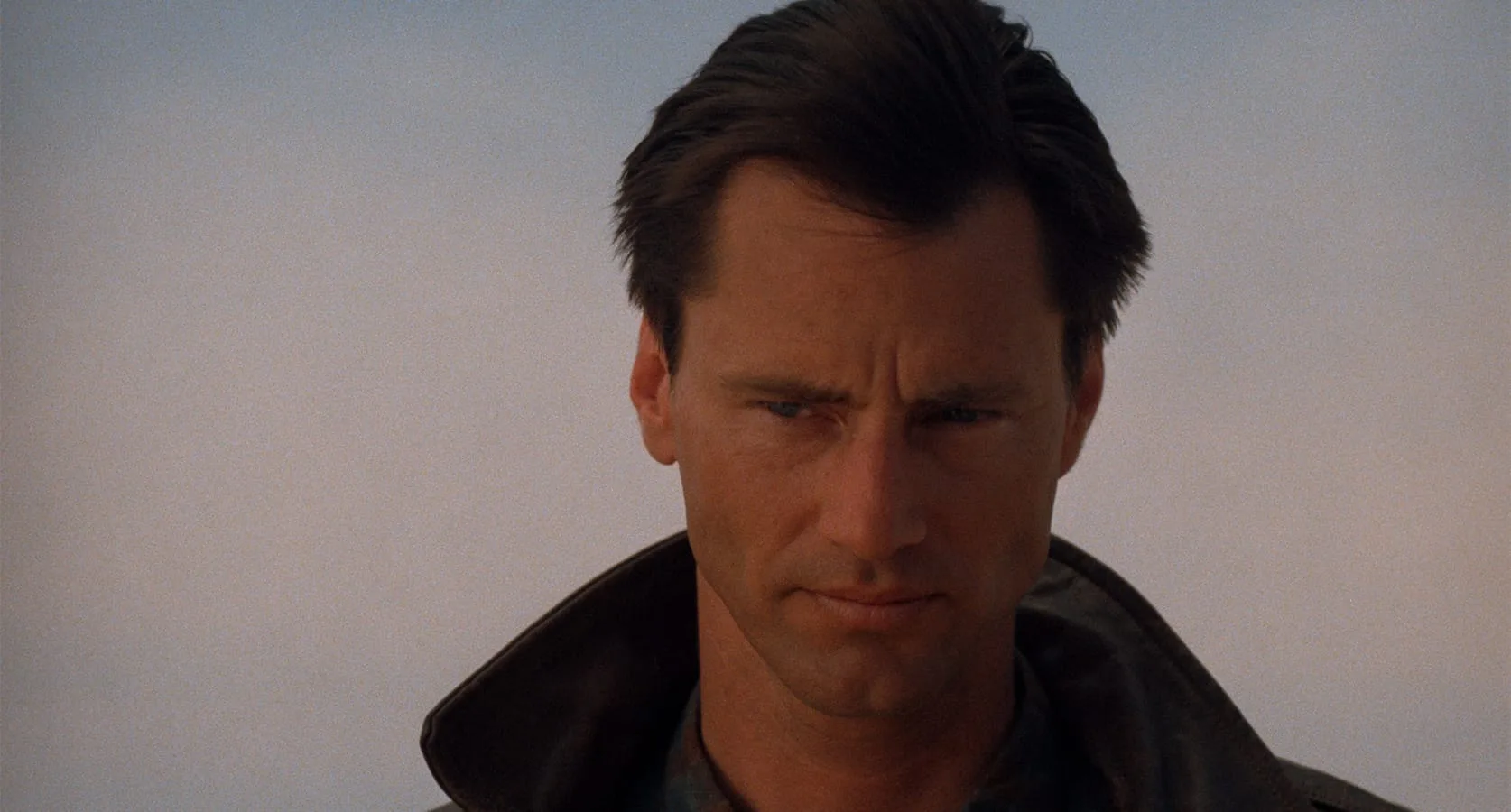
“The Right Stuff” is about dreaming that not only is everything possible, but that life is for us… for all of us, should we risk living. It’s waiting. Everything that we have always wanted is just on the other side of fear. “The Right Stuff” is visually stunning, brilliant, and perfect in every technical way that matters for a film to be called perfect. And it’s also an emotional powerhouse. It is the quintessential American myth peopled by gods who, like the Greek pantheon, are painfully human, riddled with jealousies and pettiness but capable of kindness and wisdom that surpasses understanding. They are absolutely recognizable as just you and me after we have been forged in the crucible of time and the trials in which we all of us burn. Oh Lord, what a heavenly light.
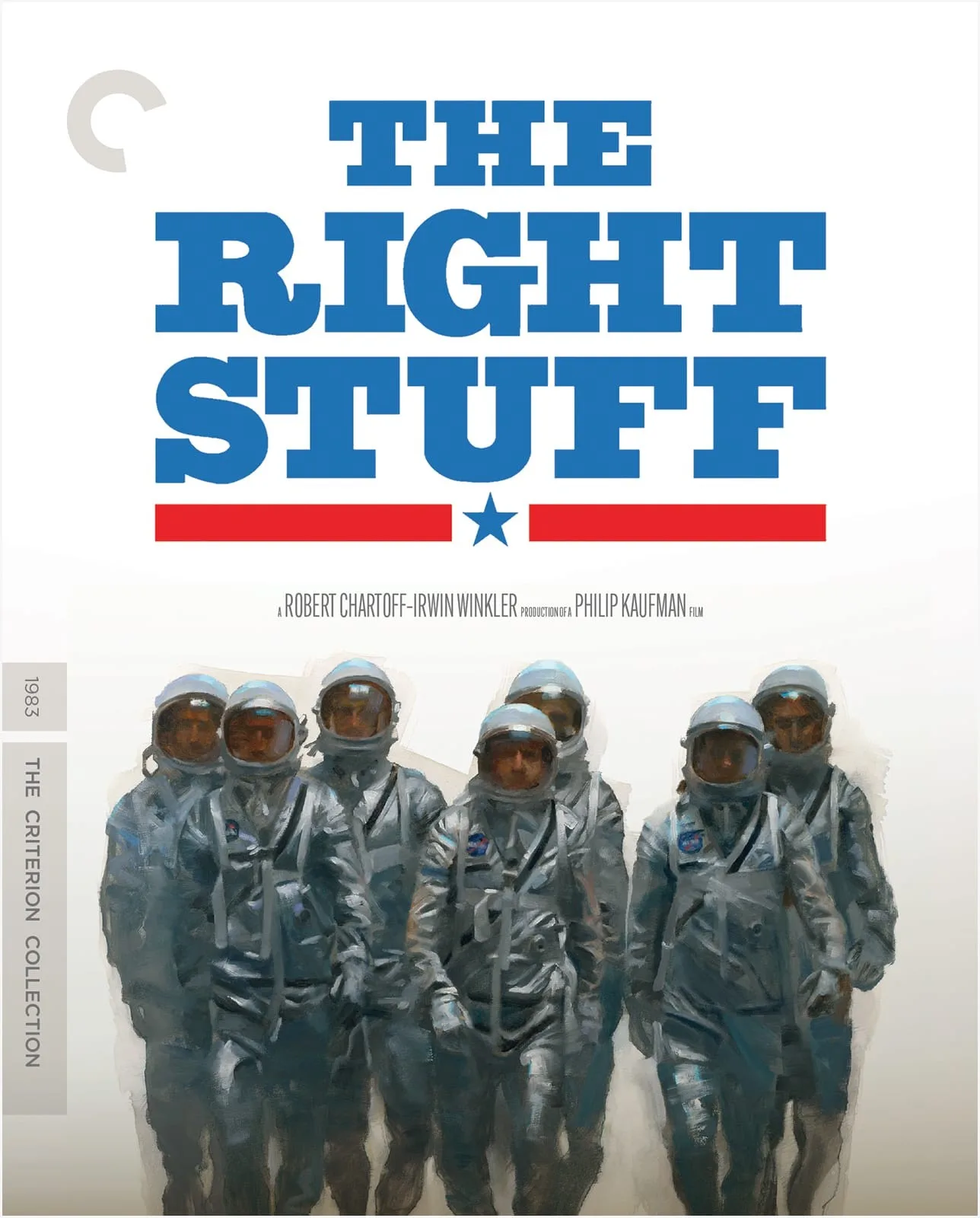
Criterion has released “The Right Stuff” now in an incomparable 4K transfer. I have seen it in every home video iteration, and this is easily the best. The restoration has been supervised by Dechanel and includes an uncompressed 5.1 DTS-HD audio track that made my blood pump like it were propelled by a steam piston. A separate Blu-Ray is packed to the gills with special features. Archival interviews with Kaufman and scene-by-scene commentaries with him and members of the cast are full of specific recollections of the film’s “make do” spirit. It bears mentioning that the Ladd Company, which put up the final funding for the picture when it was in danger of all falling through, had an extraordinary—if not profitable—run in the early 1980s with three sci-fi classics: “Blade Runner,” “Outland,” and this, “The Right Stuff,” the jewel in the company’s crown, I think, and one of the signature films of the entire decade.