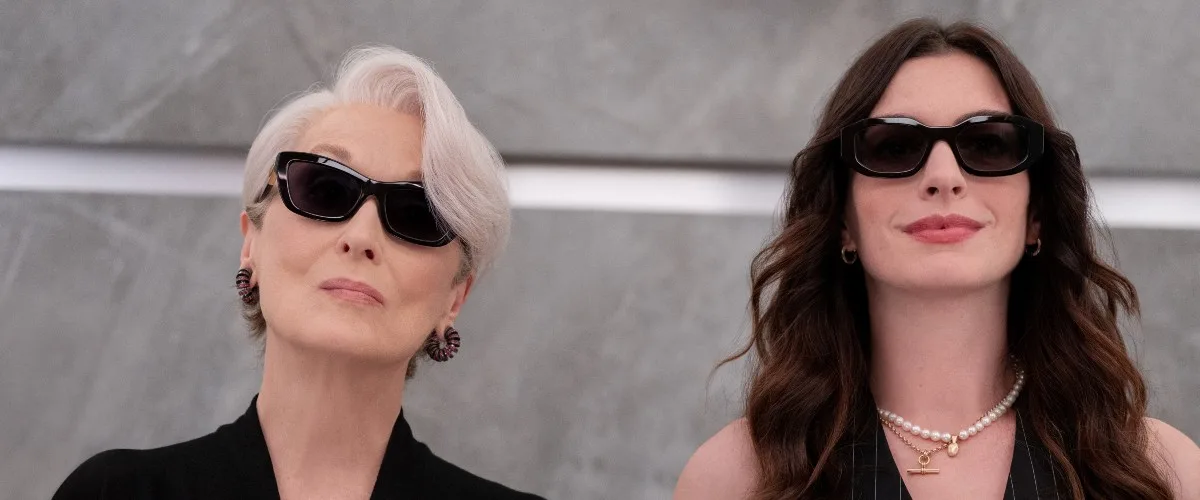
Gird your loins, fellow journalists. Amid all the luxurious high fashion and expensive high-heeled stilettos, “The Devil Wears Prada 2” reminds us of something else unattainable in today’s world. No, it is not a baby-blue Marc Jacobs bag that is “sold out everywhere.” It is, instead, a stable editorial job at a respectable publication that is more interested in serious journalism than consolidating with a tech-bro mindset and turning into a content farm before vanishing forever.
Wait, isn’t this highly anticipated follow-up to 2006’s très chic and genuinely magnifique “The Devil Wears Prada” supposed to be a bit of a fantasy where we can swoon over clothes, apartments, and lifestyles most of us cannot afford? Rest assured, there will be plenty of that—albeit, with a number of iffy wardrobe choices, more on this soon—including a Milan excursion, and a Lake Como outing somewhere in the George and Amal neighborhood. (No, the Clooneys don’t make an appearance here.) But taking a tonal cue from its predecessor, the film serves up a welcome dose of reality, too: this time, about just how bad things are everywhere in media. Parent Company. Merging. Downsizing. Content. If you find any of these words and phrases triggering, well, you at least have a supposed ally in this sequel, one that doesn’t quite find its balance or rhythm on its familiar catwalk.
The great Anne Hathaway returns as the delightful and talented Andy Sachs, now working as the kind of serious journalist she always wanted to be before becoming a Runway Magazine dropout in the first movie, which was directed by David Frankel and written by Aline Brosh McKenna in an adaptation of Lauren Weisberger’s bestseller. (Frankel and McKenna are also at the helm of this original story.)
20 years have passed since the release of the first film, and since the flip-phones depicted in it, when Andy was hired to serve as editorial legend Miranda Priestly’s (Meryl Streep, in an iconic turn) second assistant in the fashion world, and left her job abruptly during a Paris fashion week trip in the midst of a moral awakening. If I’m being honest, I cared neither for Andy’s friends nor her boyfriend Nate (Adrian Grenier) back then—I still don’t. And I never thought Andy had a moral obligation to quit her job. Sure, her boss was a true nightmare and, among other things, made work-life balance non-existent for her, but Andy had a sound plan and worked very hard to become indispensable to her team amid the opportunity of a lifetime. A little more support of her choices, and a little less dismissing of fashion as trivial and beneath her, would have gone a long way.
That subtle ambition-shaming aside, the first movie still opened a door for Andy by its end, which the sequel abruptly closes at the beginning. Adding insult to injury, Andy is about to accept a prestigious journalism award when her entire table receives the same text message that practically fires them on the spot. This kind of thing happens routinely in journalism these days after a soulless big company or an ignorant billionaire swallows up an outlet and its proud legacy; in recent years, I had colleagues stranded in places they traveled to for work, after they got fired via email and locked out of their accounts while still on the said work trip. And it is only realistic that layoffs would eventually find Andy, regardless of how talented she is. Still, she accepts her award in tears, delivering a passionate speech about the sorry state of affairs that we’re all braving in the real world.
Enter Runway and Miranda again, after Andy mysteriously lands a new job at her first professional home to reshape the editorial direction of the magazine. Battling with a PR nightmare after the magazine’s accidental praise of a highly unethical supplier, neither Miranda nor her right-hand Nigel (Stanley Tucci, wonderful) recalls Andy at first glance. She is promptly placed in an embarrassing office that looks like a stockroom and paired with the hardworking assistant Jin (Helen J Shen), who is as smart and ambitious as the young Andy. Meanwhile, Miranda’s two assistants are Amari (Simone Ashley) and Charlie (Caleb Hearon), both intriguing enough but underdeveloped. “There have been some complaints to the HR,” Charlie tells a shocked Andy in one scene when she witnesses Miranda hanging up her own coat. “Apparently, she used to throw her coats to her assistants.”
Indeed, this Miranda lives in a different world—a world where abusive bosses got their reckoning in more immediate terms (well, at least for a while), a world where work-life balance gained more urgency since Covid, and a world where print publications lost their relevance (as well as budgets) amid mindless online noise and click-driven success metrics that drive down quality. “The September issue is so thin that you can practically floss with it,” Miranda says dispassionately in a telling moment that can only mean Runway might be on its way out.
Throughout the film, there are signs of that loss of relevance in Miranda’s eyes. Streep knowingly portrays her not with overt authority and confidence, but with an undercurrent of defeat. In that, Miranda no longer seems sure of her place in a world of content that she wants to rule. (“Content” sounds like nails on a chalkboard every time someone on the screen says it.) But she seems lost in other ways too—it’s almost like neither Frankel nor McKenna knew what exactly to do with her. She is a bit softened, but not entirely—she still reaches for an offensive remark or two as Miranda does. But while those quietly delivered insults are consistent with her character in the first movie, they feel underbaked here and land like afterthoughts of a script trying to piece together a new story while winking at the old one.
That lackluster story development sadly reflects on the rest of the characters, too, including Miranda’s former first assistant Emily Charlton (Emily Blunt, also terrific), now working for Dior, considering whether or not to allocate her budget elsewhere amid Runway’s PR troubles. The movie goes out of its way to give us the fans what we want with winks at “florals for spring,” renewed old grudges, and emotional awakenings, the most memorable of which belongs to Nigel. But what it forgets to do is take the audience on a character-driven journey, as in the first movie, where everyone feels essential and every dot is connected. Much like the outlets bought out of greed and turned into a random assortment of clickbait posts, this edition feels like a disjointed collection of serviceable yet forgettable scenes.
Many of those scenes revolve around Andy getting word that Runway, as they know it, is about to become history. To save the magazine, she pursues a “Holy Grail interview” with the billionaire-philanthropist Sasha Barnes (Lucy Liu), who is coming out of an eventful divorce from her greedy tech-boss ex and is looking to give away her assets to female-forward causes she believes in. The interview is this installment’s version of “getting the unpublished manuscript of the new Harry Potter book”—except it doesn’t have the same high-stakes effect because we never quite buy into Sasha Barnes’ significance in the world the film creates, despite Liu’s best efforts. Elsewhere, there are new romantic interests for Andy and Miranda, played by Patrick Brammall and Kenneth Branagh, respectively. While they are welcome additions to the cast, we don’t feel much chemistry in these relationships, especially between Brammall and Hathaway.
Also taking a backseat here is the directorial style. The masterful opening sequence of the original movie that introduces us to the notorious Priestly by its end and unfolds like a superbly edited short film in its own right doesn’t have an equivalent here. Neither does a transformed Andy’s seamless walk through NYC streets and Runway hallways in different outfits.
The fashion here gave me brief pauses, too. Taking the costume design duties from Patricia Field is her longtime collaborator, Molly Rogers. Overall, she establishes Andy’s style soundly as an editorial powerhouse who has found her own image since the first film. Still, there is something stale about some of her pinstriped suits and looks, with one notable exception: an exquisite Armani Privé jumpsuit she wears at a key moment. Streep’s wardrobe, on the other hand, is appropriately powerful and classical when her skirt silhouettes are more fitted and pencil, and less A-line and belong to what Emily Charlton would call, “a hideous skirt convention.”
Meanwhile, it’s refreshing to see enduring pieces by Miranda that she would have collected over time, counterbalancing an inexplicable Dries Van Noten tassel-decked jacket that she wears into fashion-victim territory. As for Emily, it’s hard to imagine anyone working for Dior wearing a shirt with the word DIOR in giant letters. Still, she and Nigel seem like the only characters in the film who’ve evolved their looks in believable ways in twenty years.
What I found to be the biggest headscratcher in “The Devil Wears Prada 2” is its seemingly happy resolution, in which it is more or less a billionaire who saves the day and the future of journalism, at least for a while. True, if large sums of money can destroy meaningful and useful things, it can rebuild them too. But does it ever in today’s world, once the movie starts off engaging with us on realistic terms until its cop-out ending?
The film’s exceedingly naïve “good billionaire” angle aside, it’s nice to reunite with old characters that we love, witness a healthy dose of fan servicing—the finale between Andy and Emily is especially shameless yet wonderful—and get a glimpse of that braid-knit cerulean sweater again, which, I admit, I liked much better in its original lumpy form. But you can’t help but wish that this edition of the story was a bit more… groundbreaking.