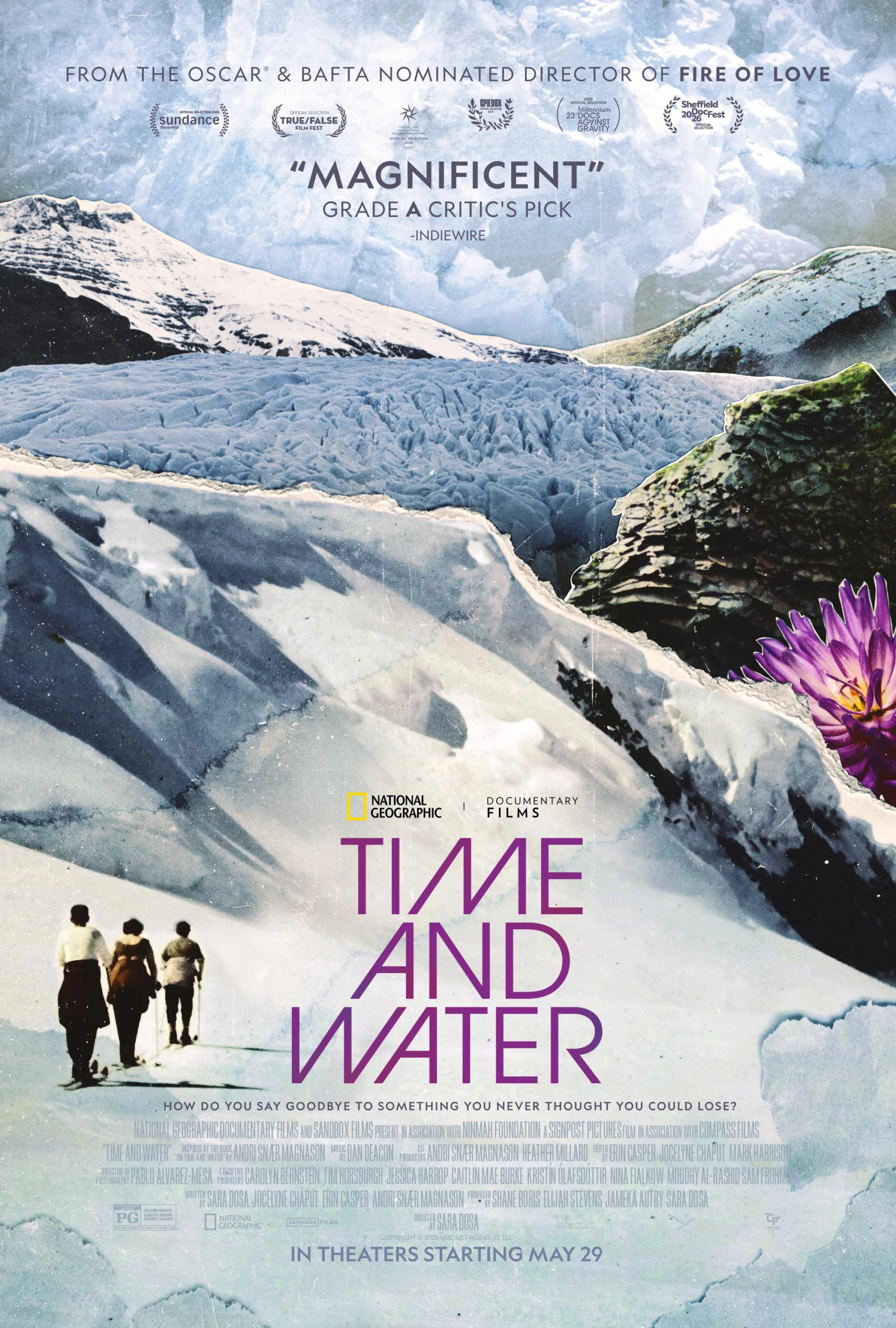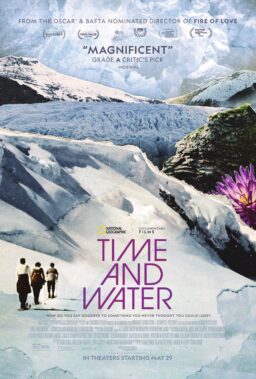

Personal stories and global history don’t collide as much as they melt into each other in director Sara Dosa’s “Time and Water.” As meditative as Dosa’s film is, make no mistake: there’s an urgency to her work, as she documents both the beauty of the natural world and its rapid decline, often in the same frame. Focusing on Iceland’s glaciers and the monumental consequence of their loss, this work makes space for both lament and celebration. It’s a homily, presented with the potency and style of performance poetry.
Truthfully, Dosa could have subjected us to portraits of the natural beauty of glaciers and pontificated about the importance of preservation via voiceover, and I would have been satisfied. What she documents is, in many ways, too urgent to worry about the capsule of the message. To our benefit, Dosa is not such a filmmaker (nor was she in her previous doc, “Fire of Love”); there’s an arresting, handcrafted beauty to her work despite the heaviness of its subject. She wisely knew that people might be more likely to adjust to her wavelength by grounding the film in specific stories. The subject in question is Icelandic writer Andri Snær Magnason, as he documents his family’s relationships to Iceland’s glaciers.
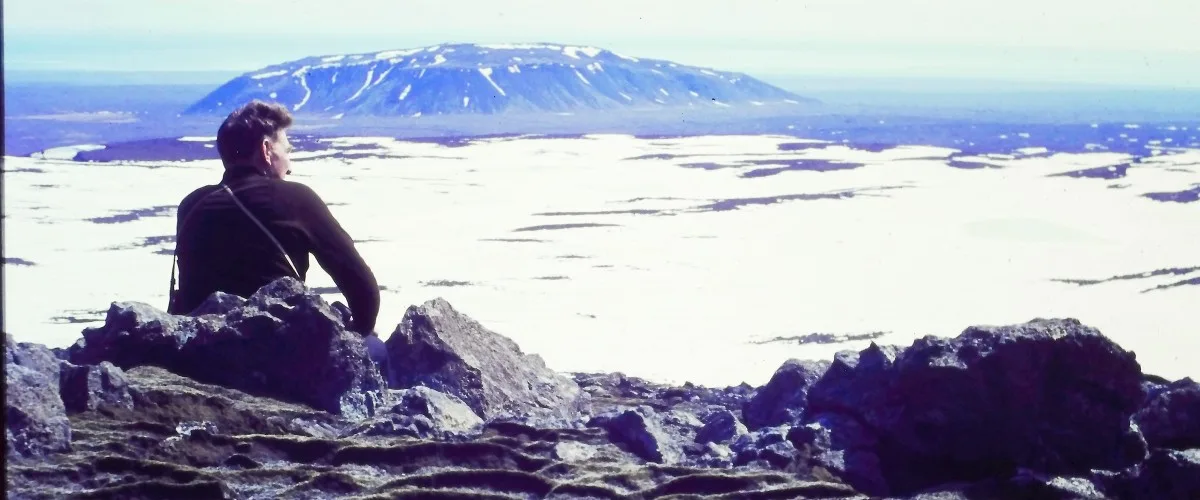
Before transitioning to what the glaciers mean to him, Magnason anchors the narrative in the story of his grandparents, Hulda and Árni, who speak of the icy kingdoms as if they’re close friends. Magnason’s grandparents have extensively documented the glaciers, and Dosa’s camera homes in on the vastness of the archive: from grainy photos to a simple focus on Hildur as he recounts stories.
Interspersed between Árni’s documentation are present-day footage of the glaciers. It’s a chilling contrast, as beautiful as it is tragic: on one hand, it’s a testament to the resilience of these landscapes to have lasted for as long as they have. On the other hand, we see just how much they have deteriorated. One haunting overhead shot sees the visible white snow taper off into dark soil. Only two generations ago, the glacier was at its full size. It’s a haunting image and a sobering reminder: we’re creating new things to mourn by the day.
Dosa invites viewers into an easy reverence in the sequencing of her footage. Editors Erin Casper, Jocelyne Chaput, and Mark Harrison don’t resort to flashy montages, nor does composer Dan Deacon rely on an overly emotional score. Scenes of waves carrying broken pieces of glaciers, sounds of ice cracking off gargantuan bodies of ice … these are the images and sounds “Time and Water” traffics in, and Dosa and her team seem aware that such elements speak for themselves. Yes, Magnason acts as our guide, but for those of us who may never go to Iceland or who have seen pictures of glaciers, Dosa asks us to be present and, in doing so, grow in affection for what we see before us. The film, in many ways, is an invitation to behold.
When Magnason says “Every glacier … a hidden world,” you believe it. Some of the most striking shots feature the camera getting up close to capture the multitude of bubbles in the ice. Each bubble carries its own history. Additionally, as we hear the ice creak and crack, it feels as though we’re listening to a living creature, like a whale calling out into the deep. There’s so much to see when you simply zoom in. Yet the larger forces driving the glaciers’ decline, through global warming and other machinations, create a distance that erodes the magic of proximity.
Dosa’s film also acknowledges how tragic it is that a film like “Time and Water” needs to exist in the first place. Early on, Magnason says, “I became the first to say goodbye to something we never thought we could use.” He delivers this with a painful sense of regret; what might Magnason and his family’s life have looked like if they didn’t have to concern themselves primarily with the survival of the glaciers? Whereas other generations were able to live their lives with the glaciers as a given, that’s not a luxury afforded to Magnason. He is the first one to have to deal with the fallout, and he can’t rely on past frameworks because the destruction is so unprecedented. That’s the cross he has to carry: doing damage control instead of dreaming.
“Time and Water” is very much a project trying to capture memory, time, and history, even as it melts before your eyes. I shudder to think that after the film’s premiere at Sundance, what the condition of Iceland’s glaciers may look like now. It’s easy to view the film merely as an audit for what we’re losing, but thankfully, Dosa avoids the trap of such sentimentality. Yes, it’s easy to mourn what we’re losing, but what she captures should inspire us to realize that the Earth is still worth fighting for. It’s not too late to save it.